
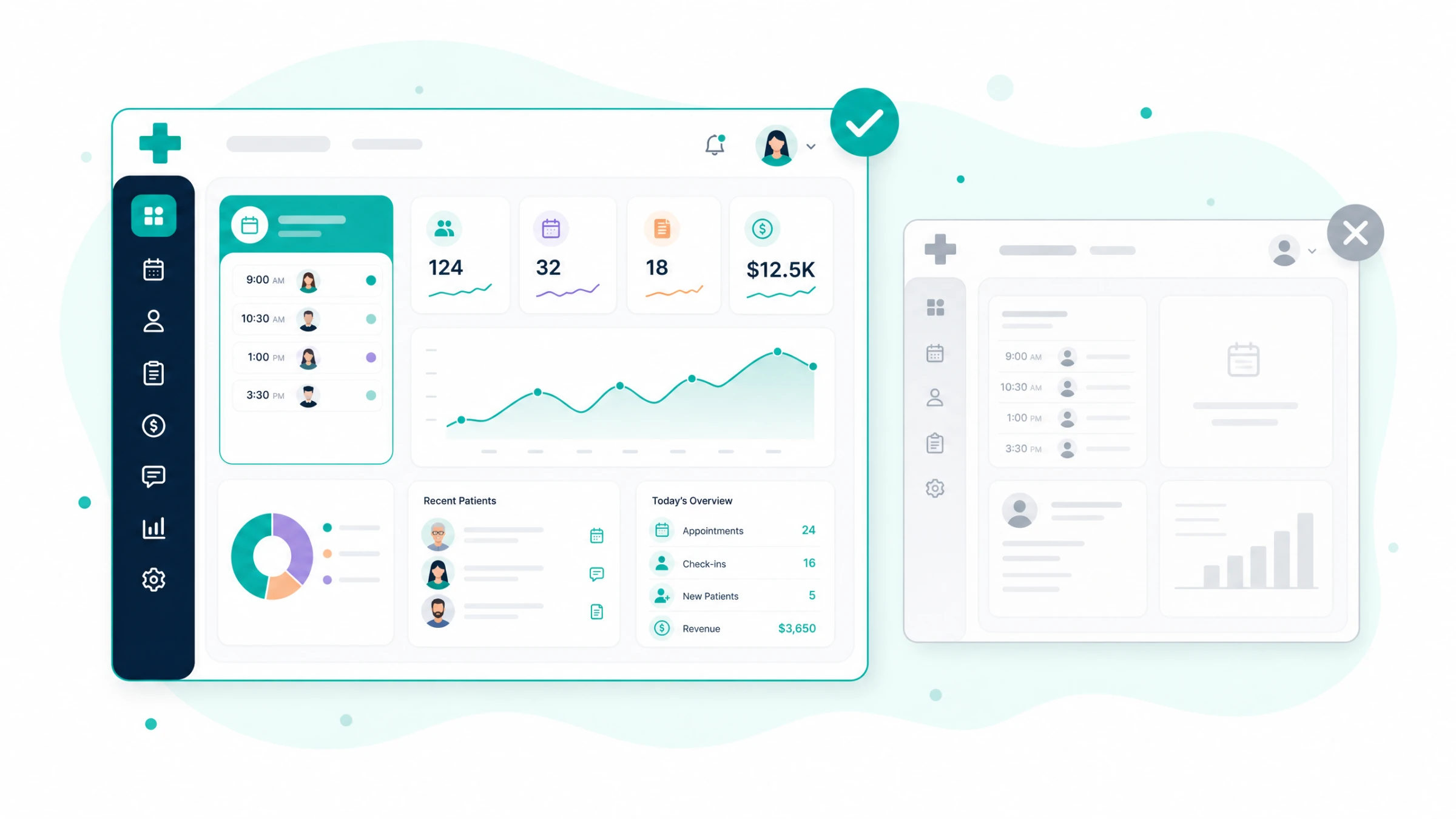
Choosing a clinic management system comes down to one non-negotiable and a handful of fit questions: the system must be HIA-compliant so it can contribute to NEHR, and beyond that, the right choice is the one that fits how your clinic actually works. This guide walks through the features that matter, cloud vs on-premise, the integrations to insist on, and what it really costs.
The 30-second version:
Start from your must-have list, not a brand. For a Singapore GP clinic the non-negotiable is an HIA-compliant HIMS - a system on Synapxe’s certified list that can contribute to NEHR by your deadline. After that, weigh the core features, the Singapore integrations (CHAS, MediSave, national schemes), cloud vs on-premise, and the total cost including grants.
Already know you need to be HIA-ready? Read the pillar: Health Information Act (HIA): What It Means for Your Clinic
Start with the non-negotiable: HIA / NEHR certification
New to the category? Start with what a clinic management system is, then come back here to choose one. Before you compare features or price, apply one filter that removes most of the risk from the decision.
If your clinic is in scope for the Health Information Act (HIA), your system must be able to contribute records to the National Electronic Health Record (NEHR) by your service type’s deadline, and only a Synapxe-certified system can do that. A system that isn’t on the certified HIMS list ↗ can’t be made compliant just by buying it.
So the practical order is:
- Shortlist only HIA-compliant systems. Confirm the vendor is on Synapxe’s certified list, or has a firm certification date before your deadline.
- Then compare on fit, features and cost among that shortlist.
Buying a non-certified system now usually means switching again before your deadline - paying twice and migrating data twice. Getting this filter right first is the single biggest way to avoid a costly mistake. For the full picture of what HIA compliance involves, see the HIA guide and the HIA compliance checklist.
The core features a clinic management system should have
Once you’re looking only at compliant systems, judge them against what a Singapore GP clinic touches every day:
- Appointment & queue management - booking, walk-in queue, and reminders. This is the front-desk workhorse; test it with your real patient flow.
- Electronic medical record (EMR) - clinical notes, diagnoses, drug allergies, and history in one record. Check how fast it is to chart a typical consult.
- Billing & claims - itemised billing plus CHAS, MediSave and other subsidy claims. Weak claim support creates daily admin drag.
- Drug inventory & dispensing - stock tracking, dispensing labels, and reorder alerts. This also matters for NEHR drug-data mapping during onboarding.
- Teleconsultation - built-in video consults and remote follow-ups, so you can offer hybrid care without bolting on a separate tool. Increasingly expected by patients.
- Reporting - the operational and financial reports you actually use, and clean data export if you ever migrate.
A longer feature list isn’t automatically better. Score each system on the features you’ll use weekly, not the ones that look impressive in a demo.
Cloud vs on-premise: which fits a clinic
This is an architecture choice, not a brand one, and for most GP clinics it leans one way.
- Cloud (web-based). The system runs on the vendor’s servers; you access it through a browser. Upside: no server to buy or maintain, automatic updates, backups handled for you, and access from the front desk, consult room or home. For most GP clinics this is the lower-effort, lower-risk choice.
- On-premise. The system runs on a server in your clinic. It can suit clinics with specific data-residency or offline requirements, but the burden of security, patching and backups falls on you, and those are exactly the CS/DS Essentials the HIA requires and the Protection duty the PDPA already imposes. That’s real, ongoing work.
If you don’t have a specific reason to run your own server, cloud usually wins on total effort and on keeping your security obligations manageable.
The Singapore integrations to insist on
A clinic system that works elsewhere isn’t automatically fit for Singapore. Check that it connects to the national systems your clinic uses:
- NEHR - contribution capability (the HIA requirement above).
- CHAS / MediSave / subsidy claims - so claims flow from billing without double entry.
- Healthier SG (HSG) - if you’re an enrolled HSG clinic, confirm the system supports the workflow, including tools like the Patient Care Summary (PCS) that pulls a patient’s care history from HSAR, NEHR and the National Immunisation Registry into one view to surface care gaps.
- Other national touchpoints your clinic uses - e.g. the National Immunisation Registry and notifiable-disease reporting to MOH.
Ask each vendor to show these working, not just list them on a slide. Integrations are where “it supports that” and “it actually does that smoothly” diverge most.
What it really costs (and the grants that help)
Cloud clinic systems are typically a subscription - monthly or annual, per clinic or per user - rather than a big upfront licence. But the sticker price isn’t the whole cost. Budget for:
- Subscription - the recurring core cost.
- Onboarding & data migration - moving records from your current system.
- Training - getting staff productive.
- Support - response times and whether it’s included.
The offset is government funding, and it splits along the same two buckets. The NEHR Connect Grant (NCG) helps cover adopting or enhancing a compliant HIMS - roughly two years of subscription for a GP clinic, while the security work (the CS/DS Essentials) is funded separately by CISOaaS and the Productivity Solutions Grant (PSG). We break the numbers down in the cost of HIA compliance and the NEHR Connect Grant guide.
The takeaway: compare total cost of ownership over 2-3 years, net of grants, not month-one price.
Data migration and support: the parts people underestimate
Two things decide whether a switch goes smoothly, and both are easy to overlook in a demo:
- Data migration. If you’re moving from an existing system, insist on a written migration plan from both the old and new providers - what data moves, in what format, and who’s responsible if something doesn’t. This is the same discipline the HIA guidance recommends when switching HIMS.
- Support & training. Ask about response times, onboarding help, and whether training is included. A capable system with poor support still slows your clinic down.
A short buyer’s checklist
Use these questions on every shortlisted vendor:
- Are you on Synapxe’s certified HIMS list, or what’s your firm certification date?
- Can you demonstrate NEHR contribution and CHAS/MediSave claims working?
- Is it cloud or on-premise, and who handles security, patching and backups?
- What’s the total 2-3 year cost, and which grants can we use?
- What does data migration from our current system look like, in writing?
- What are your support response times, and is training included?
If a vendor can’t answer the certification question clearly, stop there because the rest doesn’t matter until that’s settled.
Next steps
Choose in this order: HIA-compliant first, then fit and features, then total cost net of grants. That sequence protects you from the most expensive mistake: buying a system you’ll have to replace before your deadline.
Just starting out? See How to Start a Clinic in Singapore for the full setup sequence - business, licence, premises - before you choose a system.
If you’d rather not assemble the pieces yourself, OtterSG is an HIA-compliant HIMS delivered with cybersecurity and support in one programme, built to meet the NEHR contribution and CS/DS Essentials at once. See how that works →
This guide is general information for Singapore clinics choosing a management system; it is not legal or procurement advice. Grant eligibility and amounts are set by the government and may change - verify at the official portals before deciding.