
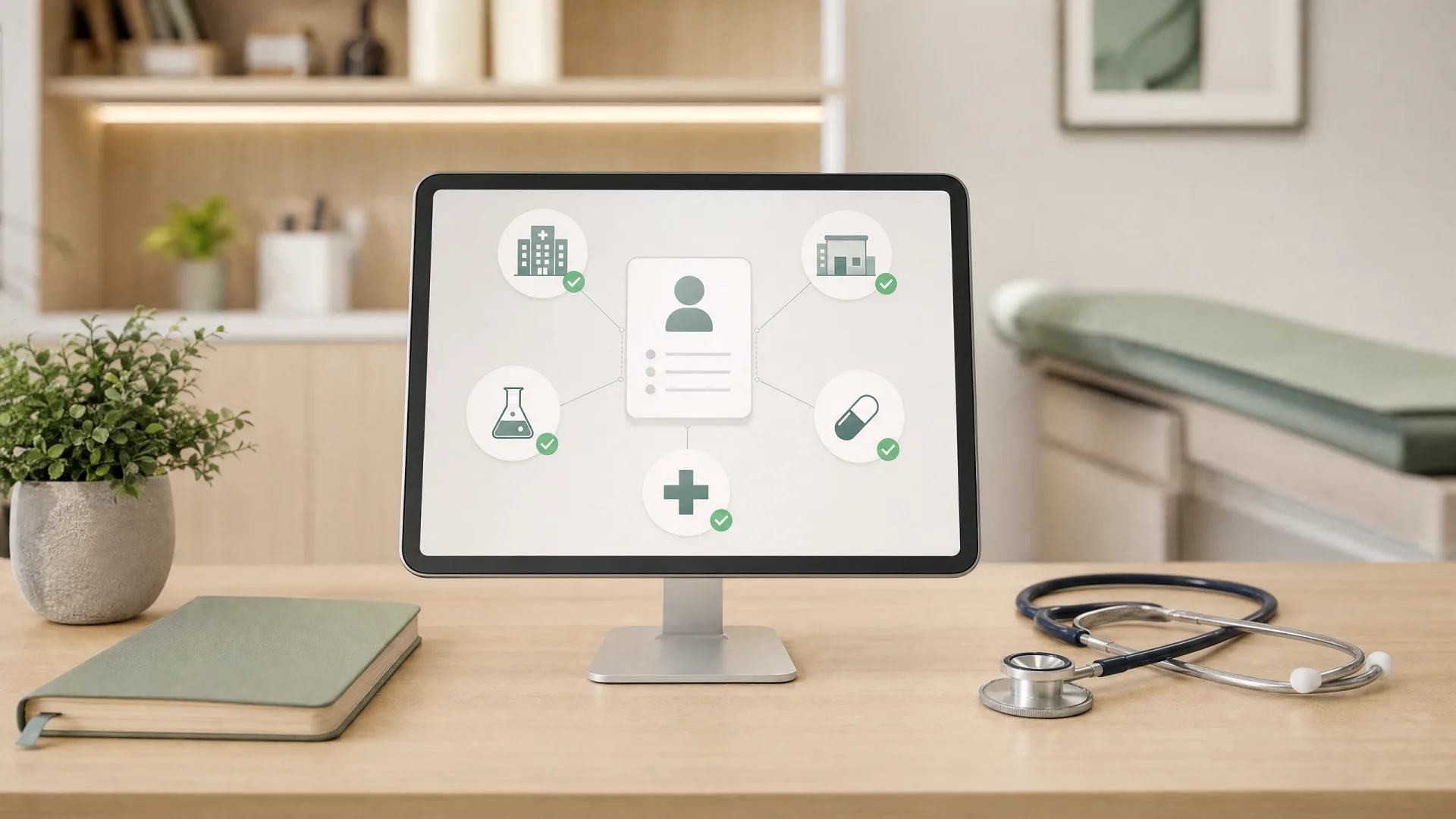
NEHR, the National Electronic Health Record, is Singapore’s shared national record of each patient’s key health information. It’s owned by MOH, run by Synapxe, and has been drawing data from public healthcare institutions since 2011. Under the Health Information Act (HIA), every licensed clinic will have to contribute to it, starting with GP clinics by 1 September 2027. This guide explains what NEHR is, how it works, who can see a patient’s record, and what it changes in your clinic day to day.
The 30-second version:
NEHR is a national repository that holds a copy of selected health information (allergies, medications, test results, procedures, discharge summaries and the like) from many providers, so the next doctor a patient sees has the key facts. It is owned by MOH and managed by Synapxe. Only healthcare professionals caring for the patient may view it, and from 2027 patients get more control through Access Restrictions (set via HealthHub), with a logged break-glass override for emergencies. Under the HIA, contributing becomes mandatory by batch: GP clinics (Outpatient Medical – GP) by 1 September 2027. NEHR doesn’t replace your clinic management system. Your system is your full record, and it sends a summary to NEHR.
Official sources: healthinfo.gov.sg/nehr ↗ (MOH) · Synapxe NEHR ↗
New to the HIA itself? Start with the pillar: Health Information Act (HIA): What It Means for Your Clinic. This article is the NEHR primer the other guides build on.
What NEHR is
The National Electronic Health Record (NEHR) is the national repository that collects and stores a copy of selected health information about a patient from the different healthcare providers they visit. A patient might see a GP, a polyclinic, a specialist and a hospital over the years, and each holds a piece of their history. NEHR pulls the key pieces into one consolidated view that authorised professionals can check when they treat that patient.
Three facts worth knowing:
- Who owns it. NEHR is owned by the Ministry of Health (MOH) and managed and operated by Synapxe, Singapore’s HealthTech Agency.
- How long it’s been running. Public healthcare institutions have contributed to NEHR since 2011. Anyone treated in Singapore’s public healthcare clusters since February 2011 already has a record. Private providers are being brought in progressively, and the HIA is what makes that universal.
- What it’s for. MOH sums up the HIA as “One Patient, One Health Summary, One Care Journey”: the aim is fewer duplicate tests, lower costs and safer care, because the treating doctor can see allergies, medications and recent results rather than relying on the patient’s memory.
How NEHR works
NEHR runs in two directions, and a clinic can sit on either side or both.
Contributing. Providers send required data from their own systems to NEHR through system-to-system integration. That data is a summary, not your full record: NEHR receives selected health information, not doctors’ notes. Examples include patient demographics, prescriptions and medications, diagnostic test results, medical procedures, discharge summaries, allergies and immunisations. Because NEHR copies what’s entered at source, corrections are made in the contributing system, not in NEHR itself.
Viewing. Authorised professionals at participating institutions log in and see the consolidated record when they’re treating that patient. Today, public healthcare institutions and private hospitals have access, and GPs, specialist centres and nursing homes are being onboarded progressively.
The exact data a clinic must send depends on its service type and is set out in the HIA’s First Schedule. For a GP clinic, that’s specific items such as visit events, medications and vaccines. We cover the detail, including what’s out of scope, in NEHR onboarding for clinics.
Who can access NEHR
This is the question patients ask clinics most, and the HIA answers it narrowly.
- Only healthcare professionals, only for care. NEHR access is for doctors, nurses, pharmacists and allied health professionals who need it for direct patient care. Administrative and corporate staff should not have NEHR access.
- Only patients under their care. Authorised individuals may view NEHR only for patients they are actively caring for. Looking up a patient who isn’t under your care is prohibited.
- Not for jobs or insurance. Access for employment or insurance purposes is prohibited, and unauthorised access of that kind is an offence under the HIA. The narrow exception is specified statutory medical examinations listed in the HIA’s Third Schedule, such as enlistment checks.
- One person, one account. Each user needs their own account, used only for the institution that issued it.
Technical controls back the rules up. NEHR uses role-based access control (professionals only see fields matching their role), limits on how many records can be opened in a timeframe, and continuous monitoring and audits by Synapxe to spot unusual access.
What patients can see and control
Patients can view their key health information on HealthHub, along with an access history showing which institutions opened their record over the past 12 months. They can report suspected unauthorised access for investigation.
Patients can already request an Access Restriction at selected public healthcare institutions. From 2027, they get more control:
- A patient can restrict NEHR access to institutions they select. Restrictions apply at institution level, not to individual doctors within an institution.
- Even with a restriction in place, providers still see a limited core set needed for safe care: name, NRIC or FIN, date of birth, race, sex, allergies and vaccination records.
- A restriction cannot be placed on the primary care provider of a Healthier SG enrollee.
- Clinics must keep contributing the required data whether or not a patient has a restriction.
For emergencies there’s a break-glass feature. In a life-threatening emergency (MOH’s examples include a severe allergic reaction, stroke or heart attack), a doctor can override an Access Restriction after re-authenticating and formally declaring the emergency. Every override is automatically logged by Synapxe, and misusing break-glass is a breach of the HIA. It must never be used for non-emergencies or simply because a patient asks.
Is NEHR compulsory?
Contributing is becoming compulsory. Viewing for every patient is not.
Under the HIA, all licensed healthcare providers must contribute key health information to NEHR, phased in by service type:
- Batch 1 (including GP clinics (Outpatient Medical – GP)): by 1 September 2027
- Batch 2 (including Specialist (Outpatient Medical) clinics and nursing homes): by 1 September 2028
- Batch 3 (including dental clinics and retail pharmacies): by 1 March 2030
The Health Information Bill was passed in Parliament on 12 January 2026, and MOH intends it to take effect from early 2027. For the full list of which service sits in which batch, see HIA deadline by clinic type, and for everything else the Act asks of you, the HIA pillar guide.
On the viewing side, MOH is explicit that you don’t need to check NEHR at every consultation. It’s an adjunctive source of information, useful when you need more history or the patient can’t recall it clearly, and it doesn’t replace history-taking, examination or professional judgement.
What it means for your clinic day to day
In practice, NEHR shows up in two places in your clinic.
Contributing happens through your system. Once your clinic management system is connected, required data flows to NEHR as part of normal charting, so you aren’t uploading anything by hand. Your job is data quality. MOH expects submissions to be timely, complete, accurate and attributable to the contributing provider, coded to national standards (such as SNOMED CT, LOINC and the Singapore Drug Dictionary), and corrected promptly if an error is found. How a clinic gets connected is covered step by step in NEHR onboarding for clinics.
Viewing needs a house policy. If your doctors and nurses will view NEHR, decide who gets accounts and write down the rules. You don’t have to start from scratch: Annex F of MOH’s HIA Implementation Guide (V2.0) is a sample policy on the use of the NEHR for institutions to adapt. Its core rules:
- Only individuals authorised by your clinic and Synapxe may access NEHR, and credentials are never shared.
- Staff view NEHR only for patients officially under your clinic’s care, even if a patient who isn’t under your care gives permission.
- An account issued by your clinic is used only for work at your clinic.
- No access for employment, insurance, administrative, audit, purely educational or research purposes unless permitted (for example, a Third Schedule medical examination or an MOH-approved purpose).
- When NEHR is viewed, document it in the patient’s case notes.
- Remove access as soon as someone no longer needs it.
Pair that with regular staff training and regular audits of how staff access NEHR. MOH expects both from providers that grant NEHR access.
NEHR vs your clinic management system (EMR)
Clinic owners often ask whether NEHR replaces their own records. It doesn’t, and the two are built for different jobs.
| Your clinic management system (EMR) | NEHR | |
|---|---|---|
| What it is | Your clinic’s complete working record | A national, shared summary across providers |
| What it holds | Everything: consultation notes, diagnoses, prescriptions, billing, inventory, appointments | A copy of selected health information, not doctors’ notes |
| Who uses it | Your clinic team | Authorised professionals caring for the patient, across institutions |
| Where corrections happen | Here, at source | Flow in from the contributing system |
Your clinic management system is where care is documented and the clinic is run. NEHR is a summarised, national view fed by systems like yours. The practical consequence is that your NEHR obligations run through your system: the standard way to contribute is an HIA-compliant clinic management system (certified for NEHR connectivity and cybersecurity, and declared compliant with MOH’s data-portability code). MOH will also offer a temporary web portal, the Alternate Contribution Channel, for clinics that need more time, but data is entered by hand, and MOH describes an integrated HIA-compliant system as the standard long-term approach. If you’re still weighing options, see what a clinic management system is and how to choose one.
Next steps
- Know your batch date. GP clinics (Outpatient Medical – GP): 1 September 2027. Check yours in HIA deadline by clinic type.
- Get connected. Read NEHR onboarding for clinics for how the connection works and what your provider handles.
- Claim the funding. The NEHR Connect Grant guide covers the grant that helps pay for a certified system.
- See the whole picture. The HIA pillar guide covers contribution, cybersecurity and deadlines together.
- Write your NEHR-use policy from the Annex F sample before your team starts viewing records.
OtterSG is a HIA-compliant clinic management system, so contributing to NEHR happens as part of your normal workflow. See how that works →
Official sources: healthinfo.gov.sg/nehr ↗ (MOH) · Synapxe NEHR ↗ · What is the Health Information Bill? ↗ (gov.sg) · MOH HIA Implementation Guide V2.0 ↗.
This guide is general information for clinic operators in Singapore; it is not legal, regulatory or medical advice. NEHR access rules, Access Restriction features and contribution deadlines are set by MOH and Synapxe and may change - always verify on the official sources before acting.