
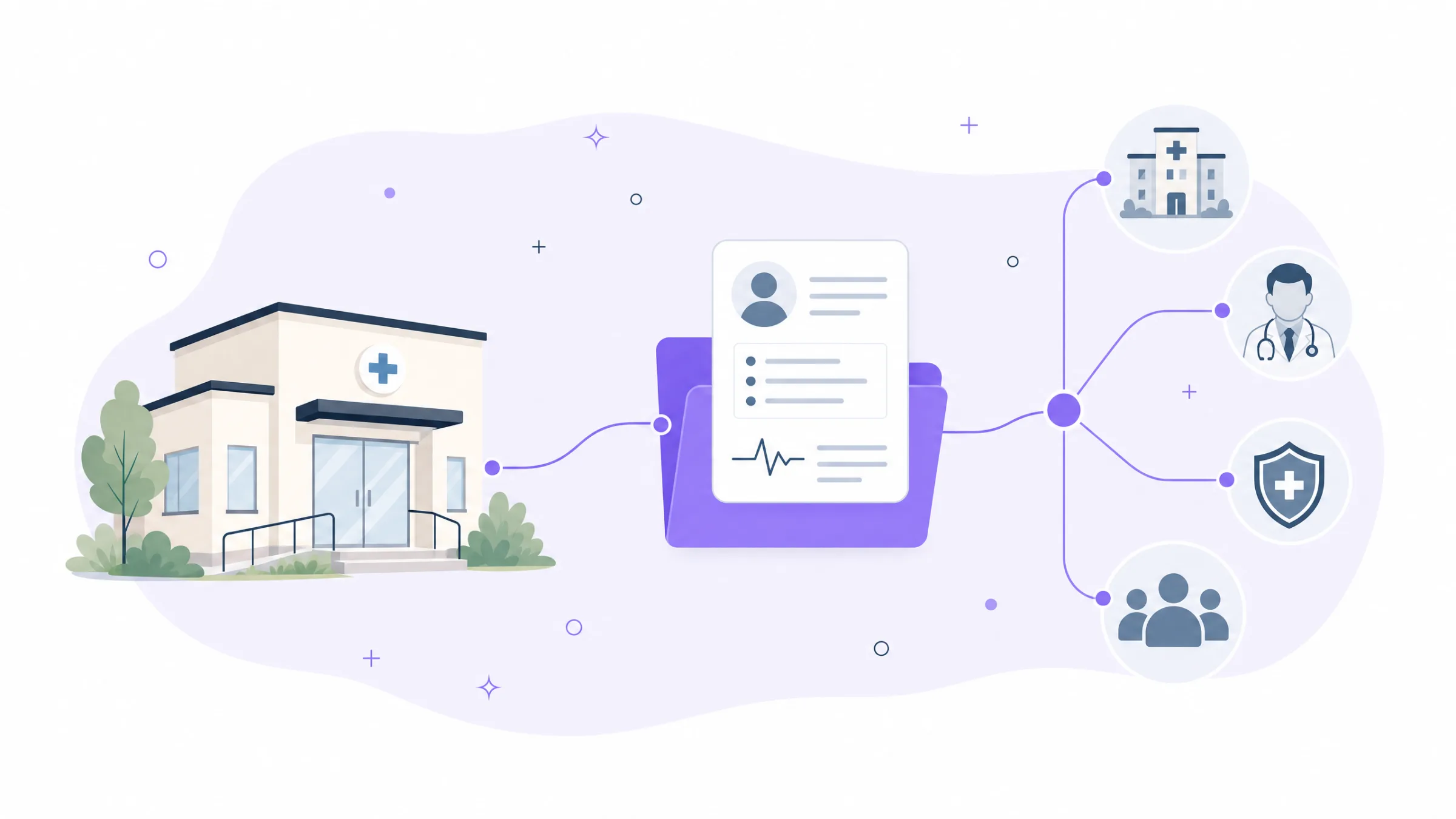
Onboarding your clinic to the National Electronic Health Record (NEHR) is a process you plan around a deadline, not a countdown you can put a fixed number of weeks on. There is no officially published clinic-level onboarding duration, so what actually drives your timeline is whether you’re already on a certified system and have closed your security gaps. The one fixed point is your HIA contribution deadline: for GP/Outpatient Medical clinics, 1 September 2027. This guide covers how the connection works, how you apply, what it costs, and the date that should anchor your planning.
The 30-second version:
You connect to NEHR by adopting a HIA-compliant HIMS - a clinic system that meets three requirements: NEHR connectivity, Cyber/Data Security certification, and Data Portability. Onboarding runs through your certified HIMS vendor, who registers your interest with Synapxe’s NEHR Vendor Engagement Team. Not digitalised yet? A transitional Alternative Contribution Channel (ACC) lets you upload manually. There’s no government onboarding fee, so the real cost is staff time (plus whatever your provider charges), and the NEHR Connect Grant helps fund the system. Duration varies by clinic; the fixed date is the 1 September 2027 GP deadline.
Official source: healthinfo.gov.sg ↗ (MOH · Synapxe)
Want the full regulatory picture first? Start with the pillar: Health Information Act (HIA): What It Means for Your Clinic - this article assumes you already understand why NEHR contribution is becoming mandatory.
Who runs NEHR, and what “onboarding” actually means
NEHR is owned by MOH and run by Synapxe, Singapore’s HealthTech Agency (formerly IHiS). For a clinic, “onboarding” isn’t a form you file with the government directly, but it’s adopting a clinic system that is certified to connect to NEHR, then having that connection set up and switched on.
The prerequisite is the part clinics get wrong. You can’t connect an arbitrary system to NEHR. You have to be on a HIA-compliant HIMS - a Health Information Management System from Synapxe’s list of HIA-compliant HIMS, which Synapxe updates as more systems qualify. If your current system isn’t on that list, your first step is adopting or upgrading to one that is, not booking an onboarding slot.
The three requirements a HIMS must meet
A HIMS is only HIA-compliant, and therefore able to onboard you to NEHR, when it meets three requirements:
- NEHR connectivity. The system can securely transmit the required health information to NEHR.
- Cyber/Data Security (CS/DS) certification. The system and its handling of data meet the required security standard.
- Data Portability. Your clinic’s data can be moved out, so you’re not locked in.
This matters for your timeline because a system already meeting all three is a very different starting point from one that still has security gaps to close. That gap, not some fixed onboarding clock, is what makes one clinic’s path shorter than another’s. If you’re still choosing a system, our buying guide to clinic management systems covers how to pick one that’s already on the compliant list.
How to apply: onboarding runs through your vendor
There’s no public “apply for NEHR access” button a clinic clicks on its own. The entry point is your certified HIMS vendor:
- Your HealthTech operator registers your interest. The certified provider you’re on (or moving to) registers your clinic, which starts the onboarding process.
- Synapxe’s NEHR Vendor Engagement Team follows up. From there, the engagement team coordinates the actual connection with your provider.
- The onboarding itself is scheduled with your provider. Because it’s arranged between Synapxe, your vendor and your clinic, the timing is something you book - it varies by clinic, and it depends on how ready your system and security posture already are.
So the honest answer to “how do I get NEHR access?” is: get onto a certified HIMS, and let that vendor initiate onboarding. The provider is your route in.
If your clinic isn’t digitalised yet
If you’re not yet on a compliant HIMS at all, there’s a transitional path: the Alternative Contribution Channel (ACC), a secure web portal for manually uploading health information. It’s designed to bridge clinics that haven’t finished moving onto a certified system - a stopgap so you can meet your obligation, not a permanent alternative to a proper HIMS.
What it costs
There is no government onboarding fee to connect to NEHR. The costs that are real:
- Staff time. The main real cost - your team’s hours to prepare, configure and verify during onboarding.
- Provider setup. Whatever your HIMS provider charges to set up and configure - this varies, and whether it’s a separate fee or bundled into your subscription differs by provider, so ask them directly.
To offset the system cost, the NEHR Connect Grant (NCG) helps fund adopting or upgrading a certified HIMS. For GPs, NCG applications open 1 July 2026 and close 31 August 2027, so the grant window and your contribution deadline sit close together, which is one more reason not to leave onboarding late. For the full cost breakdown across both the system and security buckets, see our cost of HIA compliance guide, and for the grant specifics the NEHR Connect Grant guide.
The deadline that actually drives your timeline
Because there’s no published onboarding duration, the fixed point you plan around is your HIA contribution deadline. The HIA takes effect in early 2027, and clinics start contributing in batches:
- Batch 1 - GP / Outpatient Medical: must start contributing to NEHR by 1 September 2027.
- Batch 2: September 2028.
- Batch 3: March 2030.
If you run a GP or outpatient clinic, 1 September 2027 is your anchor date. Work backwards from it: you want to be on a certified HIMS with your security gaps closed comfortably ahead of that, so onboarding is a scheduled step rather than a rush. For the full batch breakdown by service type, see HIA deadline by clinic type.
What data your clinic will contribute
Onboarding doesn’t mean uploading your entire history. You contribute key health information - things like:
- Patient demographics
- Medications and prescriptions
- Diagnostic test results
- Medical procedures
- Discharge summaries
Treat that as an illustrative summary, not the definitive list. The exact datasets are tailored to your clinic’s service type and set out precisely in the HIA First Schedule ↗ - for an Outpatient Medical (GP) clinic, for instance, that maps to specific items such as Visit Event, Ordered and Dispensed Medications, Vaccines Administered, Visit Diagnoses and Referral Memorandum. Check the First Schedule table for the precise set that applies to your service type.
A couple of scope points worth noting. On patients: only records relating to Singapore citizens, PRs and holders of a foreign identification number (FIN) are in scope, so foreign patients without a FIN are excluded, not all foreigners. On records: raw unstructured clinical notes and retrospective (historical) records are out of scope because NEHR is about structured, ongoing contribution going forward, not a bulk migration of old paper notes.
Next steps
NEHR onboarding is a process with a deadline, not a stopwatch. Get onto a HIA-compliant HIMS, close your security gaps, and let your certified vendor initiate onboarding with Synapxe as the connection itself is then scheduled with your provider, and how long it takes depends on how ready you already are. Anchor everything to your batch date: for GP/Outpatient Medical clinics, 1 September 2027.
OtterSG is a HIA-compliant clinic system, so being on a certified HIMS - and connecting to NEHR when your provider schedules it - is a planned step rather than a scramble. See how that works →
Official sources: healthinfo.gov.sg ↗ (MOH) · Synapxe NEHR.
This guide is general information for clinic operators in Singapore; it is not legal, regulatory or business advice. NEHR onboarding steps, timelines, grant windows and contribution deadlines are set by MOH and Synapxe and may change - always verify on the official sources (healthinfo.gov.sg, Synapxe, MOH) before acting.